

[Nov 19, 2021] DP-100 Test Engine files, DP-100 Dumps PDF
Latest Microsoft DP-100 PDF and Dumps (2021) Free Exam Questions Answers
Step 3: Taking Online Learning Paths
In addition, Microsoft recommends that the candidates for the DP-100 exam take online courses to adequately prepare for their test. You can find the following learning paths on the official certification webpage:
- Build AI Solutions with Azure Machine Learning
- Create Machine Learning Models
- Create No-Code Predictive Models with Azure Machine Learning
NEW QUESTION 80
You need to use the Python language to build a sampling strategy for the global penalty detection models.
How should you complete the code segment? To answer, select the appropriate options in the answer area.
NOTE: Each correct selection is worth one point.
Answer:
Explanation:
Explanation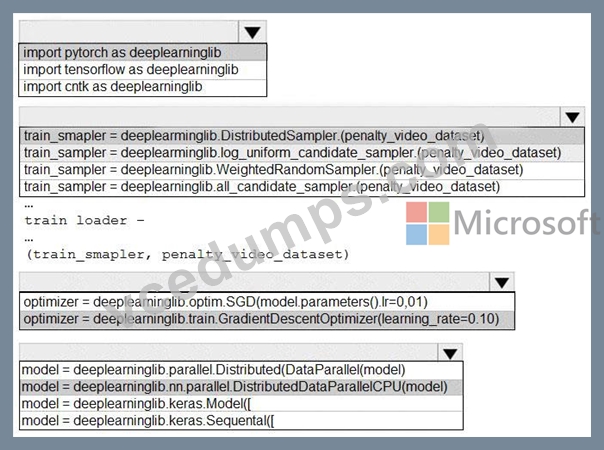
Box 1: import pytorch as deeplearninglib
Box 2: ..DistributedSampler(Sampler)..
DistributedSampler(Sampler):
Sampler that restricts data loading to a subset of the dataset.
It is especially useful in conjunction with class:`torch.nn.parallel.DistributedDataParallel`. In such case, each process can pass a DistributedSampler instance as a DataLoader sampler, and load a subset of the original dataset that is exclusive to it.
Scenario: Sampling must guarantee mutual and collective exclusively between local and global segmentation models that share the same features.
Box 3: optimizer = deeplearninglib.train. GradientDescentOptimizer(learning_rate=0.10)
NEW QUESTION 81
You are analyzing a raw dataset that requires cleaning.
You must perform transformations and manipulations by using Azure Machine Learning Studio.
You need to identify the correct modules to perform the transformations.
Which modules should you choose? To answer, drag the appropriate modules to the correct scenarios. Each module may be used once, more than once, or not at all.
You may need to drag the split bar between panes or scroll to view content.
NOTE: Each correct selection is worth one point.
Answer:
Explanation:
Explanation:
Box 1: Clean Missing Data
Box 2: SMOTE
Use the SMOTE module in Azure Machine Learning Studio to increase the number of underepresented cases in a dataset used for machine learning. SMOTE is a better way of increasing the number of rare cases than simply duplicating existing cases.
Box 3: Convert to Indicator Values
Use the Convert to Indicator Values module in Azure Machine Learning Studio. The purpose of this module is to convert columns that contain categorical values into a series of binary indicator columns that can more easily be used as features in a machine learning model.
Box 4: Remove Duplicate Rows
References:
https://docs.microsoft.com/en-us/azure/machine-learning/studio-module-reference/smote
https://docs.microsoft.com/en-us/azure/machine-learning/studio-module-reference/convert-to-indicator-values
NEW QUESTION 82
Note: This question is part of a series of questions that present the same scenario. Each question in the series contains a unique solution that might meet the stated goals. Some question sets might have more than one correct solution, while others might not have a correct solution.
After you answer a question in this section, you will NOT be able to return to it. As a result, these questions will not appear in the review screen.
You are creating a new experiment in Azure Machine Learning Studio.
One class has a much smaller number of observations than tin- other classes in the training set.
You need to select an appropriate data sampling strategy to compensate for the class imbalance.
Solution: You use the Principal Components Analysis (PCA) sampling mode.
Does the solution meet the goal?
- A. No
- B. Yes
Answer: A
Explanation:
Instead use the Synthetic Minority Oversampling Technique (SMOTE) sampling mode.
Note: SMOTE is used to increase the number of underepresented cases in a dataset used for machine learning. SMOTE is a better way of increasing the number of rare cases than simply duplicating existing cases.
Incorrect Answers:
The Principal Component Analysis module in Azure Machine Learning Studio (classic) is used to reduce the dimensionality of your training data. The module analyzes your data and creates a reduced feature set that captures all the information contained in the dataset, but in a smaller number of features.
References:
https://docs.microsoft.com/en-us/azure/machine-learning/studio-module-reference/smote
https://docs.microsoft.com/en-us/azure/machine-learning/studio-module-reference/principal-component-analysis
NEW QUESTION 83
YOU have a data-set that contains over 150 features. You use the dataset to train a Support Vector Machine (SVM) binary classifirer.
You need to use the Permutation Feature Importance module in Azure Machine Learning Studio to compute a set of feature importance scores for the dataset.
In which order should you perform the actions? To answer move al actions from from the list of Actions to the answer area and arrange them in the correct order.
Answer:
Explanation:
NEW QUESTION 84
You have an Azure Machine Learning workspace that contains a CPU-based compute cluster and an Azure Kubernetes Services (AKS) inference cluster. You create a tabular dataset containing data that you plan to use to create a classification model.
You need to use the Azure Machine Learning designer to create a web service through which client applications can consume the classification model by submitting new data and getting an immediate prediction as a response.
Which three actions should you perform in sequence? To answer, move the appropriate actions from the list of actions to the answer area and arrange them in the correct order.
Answer:
Explanation:
Explanation:
Step 1: Create and start a Compute Instance
To train and deploy models using Azure Machine Learning designer, you need compute on which to run the training process, test the model, and host the model in a deployed service.
There are four kinds of compute resource you can create:
Compute Instances: Development workstations that data scientists can use to work with data and models.
Compute Clusters: Scalable clusters of virtual machines for on-demand processing of experiment code.
Inference Clusters: Deployment targets for predictive services that use your trained models.
Attached Compute: Links to existing Azure compute resources, such as Virtual Machines or Azure Databricks clusters.
Step 2: Create and run a training pipeline..
After you've used data transformations to prepare the data, you can use it to train a machine learning model. Create and run a training pipeline Step 3: Create and run a real-time inference pipeline After creating and running a pipeline to train the model, you need a second pipeline that performs the same data transformations for new data, and then uses the trained model to inference (in other words, predict) label values based on its features. This pipeline will form the basis for a predictive service that you can publish for applications to use.
Reference:
https://docs.microsoft.com/en-us/learn/modules/create-classification-model-azure-machine-learning-designer/
NEW QUESTION 85
You create an experiment in Azure Machine Learning Studio- You add a training dataset that contains 10.000 rows. The first 9.000 rows represent class 0 (90 percent). The first 1.000 rows represent class 1 (10 percent).
The training set is unbalanced between two Classes. You must increase the number of training examples for class 1 to 4,000 by using data rows. You add the Synthetic Minority Oversampling Technique (SMOTE) module to the experiment.
You need to configure the module.
Which values should you use? To answer, select the appropriate options in the dialog box in the answer area.
NOTE: Each correct selection is worth one point.
Answer:
Explanation:
NEW QUESTION 86
You publish a batch inferencing pipeline that will be used by a business application.
The application developers need to know which information should be submitted to and returned by the REST interface for the published pipeline.
You need to identify the information required in the REST request and returned as a response from the published pipeline.
Which values should you use in the REST request and to expect in the response? To answer, select the appropriate options in the answer area.
NOTE: Each correct selection is worth one point.
Answer:
Explanation:
Reference:
https://docs.microsoft.com/en-us/azure/machine-learning/tutorial-pipeline-batch-scoring-classification
NEW QUESTION 87
An organization creates and deploys a multi-class image classification deep learning model that uses a set of labeled photographs.
The software engineering team reports there is a heavy inferencing load for the prediction web services during the summer. The production web service for the model fails to meet demand despite having a fully-utilized compute cluster where the web service is deployed.
You need to improve performance of the image classification web service with minimal downtime and minimal administrative effort.
What should you advise the IT Operations team to do?
- A. Increase the minimum node count of the compute cluster where the web service is deployed.
- B. Increase the node count of the compute cluster where the web service is deployed.
- C. Create a new compute cluster by using larger VM sizes for the nodes, redeploy the web service to that cluster, and update the DNS registration for the service endpoint to point to the new cluster.
- D. Increase the VM size of nodes in the compute cluster where the web service is deployed.
Answer: B
NEW QUESTION 88
You use the Azure Machine Learning Python SDK to define a pipeline to train a model.
The data used to train the model is read from a folder in a datastore.
You need to ensure the pipeline runs automatically whenever the data in the folder changes.
What should you do?
- A. Create a ScheduleRecurrance object with a Frequency of auto. Use the object to create a Schedule for the pipeline
- B. Set the regenerate_outputs property of the pipeline to True
- C. Create a PipelineParameter with a default value that references the location where the training data is stored
- D. Create a Schedule for the pipeline. Specify the datastore in the datastore property, and the folder containing the training data in the path_on_datascore property
Answer: D
Explanation:
Reference:
https://docs.microsoft.com/en-us/azure/machine-learning/how-to-trigger-published-pipeline
NEW QUESTION 89
Note: This question is part of a series of questions that present the same scenario. Each question in the series contains a unique solution that might meet the stated goals. Some question sets might have more than one correct solution, while others might not have a correct solution.
After you answer a question in this section, you will NOT be able to return to it. As a result, these questions will not appear in the review screen.
You train a classification model by using a logistic regression algorithm.
You must be able to explain the model's predictions by calculating the importance of each feature, both as an overall global relative importance value and as a measure of local importance for a specific set of predictions.
You need to create an explainer that you can use to retrieve the required global and local feature importance values.
Solution: Create a TabularExplainer.
Does the solution meet the goal?
- A. No
- B. Yes
Answer: A
Explanation:
Explanation
Instead use Permutation Feature Importance Explainer (PFI).
Note 1:
Note 2: Permutation Feature Importance Explainer (PFI): Permutation Feature Importance is a technique used to explain classification and regression models. At a high level, the way it works is by randomly shuffling data one feature at a time for the entire dataset and calculating how much the performance metric of interest changes. The larger the change, the more important that feature is. PFI can explain the overall behavior of any underlying model but does not explain individual predictions.
Reference:
https://docs.microsoft.com/en-us/azure/machine-learning/how-to-machine-learning-interpretability
NEW QUESTION 90
Note: This question is part of a series of questions that present the same scenario. Each question in the series contains a unique solution that might meet the stated goals. Some question sets might have more than one correct solution, while others might not have a correct solution.
After you answer a question in this section, you will NOT be able to return to it. As a result, these questions will not appear in the review screen.
You are using Azure Machine Learning to run an experiment that trains a classification model.
You want to use Hyperdrive to find parameters that optimize the AUC metric for the model. You configure a HyperDriveConfig for the experiment by running the following code: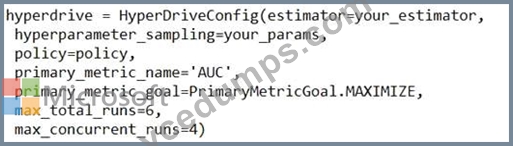
You plan to use this configuration to run a script that trains a random forest model and then tests it with validation data. The label values for the validation data are stored in a variable named y_test variable, and the predicted probabilities from the model are stored in a variable named y_predicted.
You need to add logging to the script to allow Hyperdrive to optimize hyperparameters for the AUC metric.
Solution: Run the following code:
Does the solution meet the goal?
- A. No
- B. Yes
Answer: A
Explanation:
Explanation
Use a solution with logging.info(message) instead.
Note: Python printing/logging example:
logging.info(message)
Destination: Driver logs, Azure Machine Learning designer
Reference:
https://docs.microsoft.com/en-us/azure/machine-learning/how-to-debug-pipelines
NEW QUESTION 91
Note: This question is part of a series of questions that present the same scenario. Each question in the series contains a unique solution that might meet the stated goals. Some question sets might have more than one correct solution, while others might not have a correct solution.
After you answer a question in this section, you will NOT be able to return to it. As a result, these questions will not appear in the review screen.
You are creating a new experiment in Azure Learning learning Studio.
One class has a much smaller number of observations than the other classes in the training You need to select an appropriate data sampling strategy to compensate for the class imbalance.
Solution: You use the Synthetic Minority Oversampling Technique (SMOTE) sampling mode.
Does the solution meet the goal?
- A. No
- B. Yes
Answer: B
Explanation:
SMOTE is used to increase the number of underepresented cases in a dataset used for machine learning. SMOTE is a better way of increasing the number of rare cases than simply duplicating existing cases.
References:
https://docs.microsoft.com/en-us/azure/machine-learning/studio-module-reference/smote
NEW QUESTION 92
You are performing sentiment analysis using a CSV file that includes 12,000 customer reviews written in a short sentence format. You add the CSV file to Azure Machine Learning Studio and configure it as the starting point dataset of an experiment. You add the Extract N-Gram Features from Text module to the experiment to extract key phrases from the customer review column in the dataset.
You must create a new n-gram dictionary from the customer review text and set the maximum n-gram size to trigrams.
What should you select? To answer, select the appropriate options in the answer area.
NOTE: Each correct selection is worth one point.
Answer:
Explanation:
Explanation

Vocabulary mode: Create
For Vocabulary mode, select Create to indicate that you are creating a new list of n-gram features.
N-Grams size: 3
For N-Grams size, type a number that indicates the maximum size of the n-grams to extract and store. For example, if you type 3, unigrams, bigrams, and trigrams will be created.
Weighting function: Leave blank
The option, Weighting function, is required only if you merge or update vocabularies. It specifies how terms in the two vocabularies and their scores should be weighted against each other.
References:
https://docs.microsoft.com/en-us/azure/machine-learning/studio-module-reference/extract-n-gram-features-from-
NEW QUESTION 93
You are creating a new experiment in Azure Machine Learning Studio. You have a small dataset that has missing values in many columns. The data does not require the application of predictors for each column. You plan to use the Clean Missing Data.
You need to select a data cleaning method.
Which method should you use?
- A. Replace using MICE
- B. Normalization
- C. Replace using Probabilistic PCA
- D. Synthetic Minority Oversampling Technique (SMOTE)
Answer: C
Explanation:
Replace using Probabilistic PCA: Compared to other options, such as Multiple Imputation using Chained Equations (MICE), this option has the advantage of not requiring the application of predictors for each column.
Instead, it approximates the covariance for the full dataset. Therefore, it might offer better performance for datasets that have missing values in many columns.
References:
https://docs.microsoft.com/en-us/azure/machine-learning/studio-module-reference/clean-missing-data
NEW QUESTION 94
You need to select a feature extraction method.
Which method should you use?
- A. Permutation Feature Importance
- B. Mood's median test
- C. Mutual information
- D. Kendall correlation
Answer: D
Explanation:
Explanation
In statistics, the Kendall rank correlation coefficient, commonly referred to as Kendall's tau coefficient (after the Greek letter ), is a statistic used to measure the ordinal association between two measured quantities.
It is a supported method of the Azure Machine Learning Feature selection.
Scenario: When you train a Linear Regression module using a property dataset that shows data for property prices for a large city, you need to determine the best features to use in a model. You can choose standard metrics provided to measure performance before and after the feature importance process completes. You must ensure that the distribution of the features across multiple training models is consistent.
References:
https://docs.microsoft.com/en-us/azure/machine-learning/studio-module-reference/feature-selection-modules
NEW QUESTION 95
You need to identify the methods for dividing the data according to the testing requirements.
Which properties should you select? To answer, select the appropriate options in the answer area.
NOTE: Each correct selection is worth one point.
Answer:
Explanation:
NEW QUESTION 96
You create a datastore named training_data that references a blob container in an Azure Storage account. The blob container contains a folder named in which multiple comma-separated values (CSV) files are stored.
You have a script named train.py in a local folder named ./script that you plan to run as an experiment using an estimator. The script includes the following code to read data from the csv_files folder:
You have the following script.
You need to configure the estimator for the experiment so that the script can read the data from a data reference named data_ref that references the csv_files folder in the training_data datastore.
Which code should you use to configure the estimator?
- A. Option B
- B. Option A
- C. Option C
- D. Option E
- E. Option D
Answer: A
Explanation:
Explanation
Besides passing the dataset through the inputs parameter in the estimator, you can also pass the dataset through script_params and get the data path (mounting point) in your training script via arguments. This way, you can keep your training script independent of azureml-sdk. In other words, you will be able use the same training script for local debugging and remote training on any cloud platform.
Example:
from azureml.train.sklearn import SKLearn
script_params = {
# mount the dataset on the remote compute and pass the mounted path as an argument to the training script
'--data-folder': mnist_ds.as_named_input('mnist').as_mount(),
'--regularization': 0.5
}
est = SKLearn(source_directory=script_folder,
script_params=script_params,
compute_target=compute_target,
environment_definition=env,
entry_script='train_mnist.py')
# Run the experiment
run = experiment.submit(est)
run.wait_for_completion(show_output=True)
Reference:
https://docs.microsoft.com/es-es/azure/machine-learning/how-to-train-with-datasets
NEW QUESTION 97
......
Pass Your Microsoft Azure DP-100 Exam on Nov 19, 2021 with 230 Questions: https://www.vcedumps.com/DP-100-examcollection.html
DP-100 Free Exam Study Guide! (Updated 230 Questions): https://drive.google.com/open?id=1jczFiRNdsSRJA6Y4uh9wQvMA_nPhPGG7
