

View 1Z0-082 Exam Question Dumps With Latest Demo [Feb 20, 2023]
Free 1Z0-082 Test Questions Real Practice Test Questions
How to Prepare for Oracle 1z0-082: Oracle Database Administration 1 Exam
Preparation Guide for Oracle 1z0-082: Oracle Database Administration 1 Exam
Introduction
Oracle, based in California, is an American multinational Information Technology company. Oracle is an international company that develops software applications for business. To help enterprises develop their operations, Oracle provides a variety of cloud-based applications and systems as well as hardware and services. Data management, business analytics, IT operations management, enterprise resource planning, security, and emerging technologies are the focus of Oracle's applications. Oracle is best known for its database software and technology. Oracle Database, a relational Database Management System (DBMS), is one of the most popular corporate database products.
Oracle also develops and builds tools and technologies for database management systems for middle-tier applications, Human Capital Management systems (HCM), Customer Relationship Management systems (CRM), Enterprise Resource Planning systems (ERP), and Supply Chain Management systems (SCM). Oracle Database commonly known as Oracle Database Management System (DBMS) is a multi-model database management system. It is a widely used database to run tasks for Data warehousing and Online Transaction processing databases. Different service providers make Oracle Database accessible on cloud, premises, or a hybrid cloud installation.
Topics of Oracle 1z0-082: Oracle Database Administration I Exam
The Oracle 1Z0-068 practice exams the abilities and knowledge of the candidates by checking the following objectives of 1z0-068 exam dumps:
Understanding Oracle Database Architecture - Oracle Database: Administration Workshop
- Understanding Oracle Database Server Architecture
- Understanding Oracle Database Memory and Process Structures
- Understanding Logical and Physical Database Structures
- Understanding Oracle Database Instance Configurations
Managing Database Instances - Oracle Database: Administration Workshop
- Starting Up Oracle Database Instances
- Using the Alert Log and Trace Files
- Using Data Dictionary Views
Managing Users, Roles, and Privileges - Oracle Database: Administration Workshop
- Applying the Principle of Least Privilege
- Administering User Authentication Methods
- Assigning Quotas to Users
- Creating and Assigning Profiles
- Managing Oracle Database Users, Privileges, and Roles
Managing Storage - Oracle Database: Administration Workshop
- Managing Different Types of Segments
- Shrinking Segments
- Understanding Block Space Management
- Using Table and Row Compression
Moving Data - Oracle Database: Administration Workshop
- Using SQL Loader
- Using External Tables
- Using Oracle Data Pump
Accessing an Oracle Database with Oracle supplied Tools - Oracle Database: Administration Workshop
- Using SQL Plus
- Using Oracle Enterprise Manager Cloud Control
- Using oracle enterprise Manager Database Express
- Using the Database Configuration Assistant (DBCA)
- Using SQL Developer
Configuring Oracle Net Services - Oracle Database: Administration Workshop
- Comparing Dedicated and Shared Server Configurations
- Connecting to an Oracle Database Instance
- Using Oracle Net Services Administration Tools
Managing Tablespaces and Datafiles - Oracle Database: Administration Workshop
- Managing Table Data Storage
- Creating, Altering, and Dropping Tablespaces
- Implementing Oracle Managed Files
- Viewing Tablespace Information
- Moving and Renaming Online Data Files
Managing Undo - Oracle Database: Administration Workshop
- Using the DEFINE and VERIFY commands
- Restricting and Sorting Data - Oracle Database: Introduction to SQL
- Comparing Undo Data and Redo Data
- Configuring Undo Retention
- Applying Rules of precedence for operators in an expression
- Using Substitution Variables
- Storing Undo Information
Using Conversion Functions and Conditional Expressions - Oracle Database: Introduction to SQL
- Performing arithmetic with date data
- Using The MINUS operator
- Manipulating strings with character functions in SQL SELECT and WHERE clauses
- Using Various Types of Joins
- Matching the SELECT statements
- Using Column aliases
- Using Self-joins
- Retrieving Data using the SQL SELECT Statement - Oracle Database: Introduction to SQL
- Using concatenation operator, literal character strings, alternative quote operator, and the DISTINCT keyword
- Understanding implicit and explicit data type conversion
- Using Single-Row Functions to Customize Output - Oracle Database: Introduction to SQL
- Using Non-equijoins
- Using The INTERSECT operator
- Applying the NVL, NULLIF, and COALESCE functions to data
- Managing Views
- Using OUTER joins
- Working with INTERVAL data types
- Using SET Operators - Oracle Database: Introduction to SQL
- Using Data Definition Language
- Using The SQL SELECT statement
- Nesting multiple functions
- Manipulating numbers with the ROUND, TRUNC, and MOD functions
- Using the TO_CHAR, TO_NUMBER, and TO_DATE conversion functions
- Manipulating dates with the date function
- Managing Data in Different Time Zones - Oracle Database: Introduction to SQL
- Using Arithmetic expressions and NULL values in the SELECT statement
- Working with CURRENT_DATE, CURRENT_TIMESTAMP, and LOCALTIMESTAMP
- Using The DESCRIBE command
- Managing Views - Oracle Database: Introduction to SQL
- Displaying Data from Multiple Tables Using Joins - Oracle Database: Introduction to SQL
- Understanding Data Definition Language - Oracle Database: Introduction to SQL
- Using the ORDER BY clause in set operations
Reporting Aggregated Data Using Group Functions - Oracle Database: Introduction to SQL
- Using Subqueries to Solve Queries - Oracle Database: Introduction to SQL
- Managing Sequences, Synonyms, Indexes - Oracle Database: Introduction to SQL
- Using Group Functions
- Managing Synonyms
- Controlling transactions
- Creating and using temporary tables
- Using Multiple Row Subqueries
- Using Single-Row Subqueries
- Restricting Group Results
- Managing Tables using DML statements - Oracle Database: Introduction to SQL
- Managing Database Transactions
- Creating Groups of Data
- Managing constraints
- Managing Sequences
How to book the Oracle 1z0-082: Oracle Database Administration I Exam
If you are looking to appear in the Oracle 1z0-082: Oracle Database Administration I Exam, you can do so by either redeeming a voucher that you have to buy from Oracle or paying directly with a credit card. After payment, you can schedule the test via Oracle's external testing provider, PearsonVue.
NEW QUESTION 17
Which three statements are true about the naming methods and their features supported by Oracle database used to resolve connection information?
- A. Directory Naming requires setting the TNS_ADMIN environment variable on the client side.
- B. Local Naming requires setting the TNS_ADMIN environment variable on the client side.
- C. Local naming can be used if Connect-Time Failover Is required.
- D. A client can connect to an Oracle database instance even If no client side network admin has been configured.
- E. Directory Naming can be used if Connect-Time Failover is required.
- F. Easy Connect supports TCP/IP and SSL.
Answer: A,C,D
NEW QUESTION 18
You execute this query:
SELECT TO_CHAR(NEXT_DAY(LAST_DAY(SYSDATE), `MON'), `dd "Monday for"
fmMonth rrrr')
What is the result?
- A. It returns the date for the last Monday of the current month
- B. It generates an error
- C. It returns the date for the first Monday of the next month
- D. It executes successfully but does not return any result
Answer: C
NEW QUESTION 19
Which three statements are true about advanced connection options supported by Oracle Net for connection to Oracle Database instances? (Choose three.)
- A. Source Routing requires the use of a name server
- B. Load Balancing can balance the number of connections to dispatchers when using a Shared Server configuration
- C. Source Routing enables the use of Connection Manager (CMAN) which enables network traffic to be routed through a firewall
- D. Connect Time Failover requires the use of Transparent Application Failover (TAF)
- E. Load Balancing requires the use of a name server
- F. Connect Time Failover requires the connect string to have two or more listener addresses configured
Answer: A,C,F
Explanation:
https://docs.oracle.com/cd/E11882_01/network.112/e41945/advcfg.htm#NETAG013
NEW QUESTION 20
Which two can you use to recover a dropped table? (Choose two.)
- A. FLASHBACK QUERY
- B. FLASHBACK DATABASE
- C. FLASHBACK TRANSACTION
- D. FLASHBACK TABLE TO SCN
- E. FLASHBACK DROP
Answer: D,E
NEW QUESTION 21
In which three situations does a new transaction always start? (Choose three.)
- A. when issuing a SELECT FOR UPDATE statement after a CREATE TABLE AS SELECT statement was issued in the same session
- B. when issuing the first Data Manipulation Language (DML) statement after a COMMIT OR ROLLBACK statement was issued in the same session
- C. when issuing a CREATE INDEX statement after a CREATE TABLE statement completed successfully in the same session
- D. when issuing a CREATE TABLE statement after a SELECT statement was issued in the same session
- E. when issuing a DML statement after a DML statement failed in the same session
- F. when issuing a TRUNCATE statement after a SELECT statement was issued in the same session
Answer: A,B,C
Explanation:
https://docs.oracle.com/en/database/oracle/oracle-database/19/cncpt/transactions.html#GUID-7690181F-8293-47B9-ADC1-905BD9C3AF57
NEW QUESTION 22
Examine this description of the books table containing 100 rows: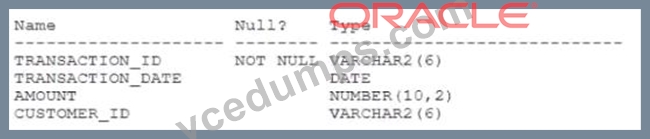
Now examine this sequence of statements Issued In a new session;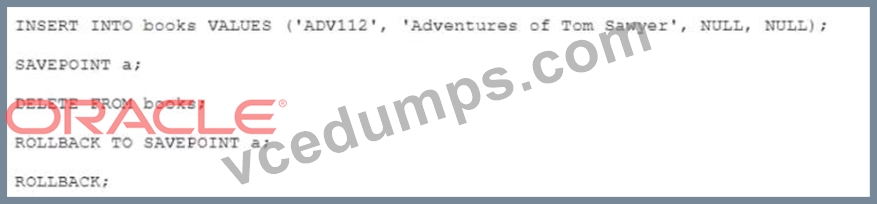
Examine this description of the books table containing 100 rows:
Which three statements are true?
- A. The first rollback command restores the 100 rows that were in the table originally.
- B. The second rollback command restores the row that was inserted.
- C. The second rollback command restores the 100 rows that were in the table originally.
- D. The first rollback command leaves the inserted row locked.
- E. The first RollBack command restores the row that was inserted.
- F. The second rollback command rolls back the rollback to savepoint a command.
- G. The first rollback command leaves the table's 100 original rows locked.
Answer: B,E,F
NEW QUESTION 23
You want to apply the principle of Least Privilege in all your live databases.
One of your requirements is to revoke unnecessary privileges from all users who have them using Privilege Analysis.
Which three types of analyses can be done using the DBMS_PRIVILEGE_CAPTURE package?
(Choose three.)
- A. analysis of privileges granted indirectly to a role that are then used by a user who has been granted that role
- B. analysis of privileges granted directly to a role that are then used by a user who has been granted that role
- C. analysis of privileges that a user has on their own schema objects that they did not use
- D. analysis of all privileges used by all users but excluding administrative users in the database
- E. analysis of all privileges used by all users including administrative users in the database
- F. analysis of privileges that a user has on their own schema objects that they did use
Answer: A,C,E
Explanation:
https://docs.oracle.com/database/121/ARPLS/d_priv_prof.htm#ARPLS74328
NEW QUESTION 24
Your database instance is started with a PFILE.
Examine these parameters: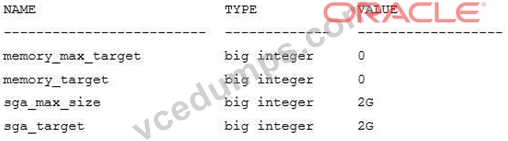
You want to increase the size of the buffer cache.
Free memory is available to increase the size of the buffer cache.
You execute the command:
SQL> ALTER SYSTEM SET DB_CACHE_SIZE=1024M;
What is the outcome?
- A. Change is applied to the current instance, but does not persist after instance restart
- B. The value is changed for the current instance and in the PFILE
- C. The value is changed only in the PFILE and takes effect at the next instance startup
- D. It fails because the SCOPE clause is missing
Answer: A
Explanation:
Explanation/Reference: https://docs.oracle.com/database/121/SQLRF/statements_2017.htm#SQLRF00902
NEW QUESTION 25
Which two statements are true about Enterprise Manager Database Express? (Choose two.)
- A. The same port number can be used for Database Express configurations for databases on different hosts
- B. It can be used to switch a database into ARCHIVELOGMODE
- C. It can be used to perform database recovery
- D. The same port number can be used for multiple Database Express configurations for multiple databases on the same host
- E. It is available only when the database is open
Answer: B,D
Explanation:
https://docs.oracle.com/en/database/oracle/oracle-database/19/admqs/getting-started-with- database-administration.html#GUID-EB851101-07BE-4038-BB9D-06E01CC7F5D5
NEW QUESTION 26
Table EMPLOYEES contains columns including EMPLOYEE_ID, JOB_ID and SALARY.
Only the EMPLOYEE_ID column is indexed.
Rows exist for employees 100 and 200.
Examine this statement: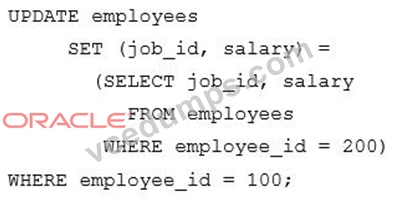
Which two statements are true? (Choose two.)
- A. Employees 100 and 200 will have the same JOB_ID as before the update command
- B. Employee 100 will have JOB_ID set to the same value as the JOB_ID of employee 200
- C. Employee 100 will have SALARY set to the same value as the SALARY of employee 200
- D. Employee 200 will have JOB_ID set to the same value as the JOB_ID of employee 100
- E. Employees 100 and 200 will have the same SALARY as before the update command
- F. Employee 200 will have SALARY set to the same value as the SALARY of employee 100
Answer: C,D
NEW QUESTION 27
View the Exhibits and examine the structure of the COSTS and PROMOTIONS tables.
You want to display PROD_IDS whose promotion cost is less than the highest cost PROD_ID in a promotion time interval.
Examine this SQL statement: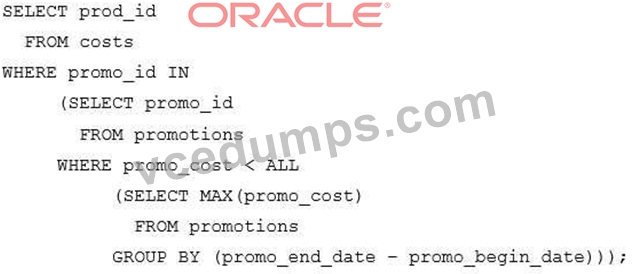
Exhibit 1.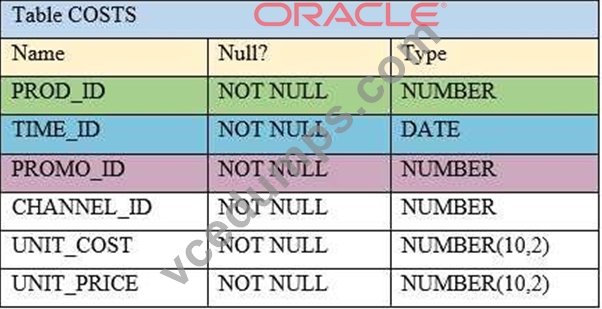
Exhibit 2.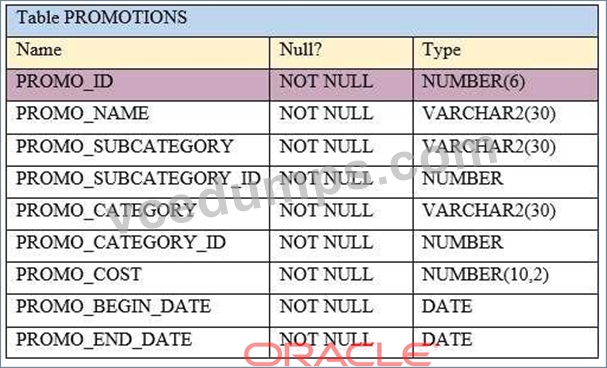
What will be the result?
- A. It gives an error because the ALL keyword is not valid
- B. It executes successfully but does not give the required result
- C. It gives an error because the GROUP BY clause is not valid
- D. It executes successfully and gives the required result
Answer: D
NEW QUESTION 28
Examine the description of the EMPLOYEES table: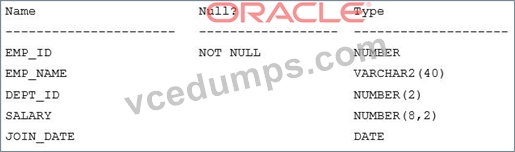
Which query is valid?
- A. SELECT dept_id, AVG(MAX(salary)) FROM employees GROUP BY dept_id;
- B. SELECT dept_id, MAX(AVG(salary)) FROM employees GROUP BY dept_id;
- C. SELECT dept_id, join_date, SUM(salary) FROM employees GROUP BY dept_id, join_date;
- D. SELECT dept_id, join_date, SUM(salary) FROM employees GROUP BY dept_id;
Answer: D
NEW QUESTION 29
Which two statements are true about single row functions? (Choose two.)
- A. CEIL : can be used for positive and negative numbers
- B. TRUNC : can be used with NUMBER and DATE values
- C. MOD : returns the quotient of a division operation
- D. CONCAT : can be used to combine any number of values
- E. FLOOR : returns the smallest integer greater than or equal to a specified number
Answer: A,B
Explanation:
Reference:
https://docs.oracle.com/en/database/oracle/oracle-database/18/sqlrf/Single-Row-Functions.html#GUID-B93F789D-B486-49FF-B0CD-0C6181C5D85C
NEW QUESTION 30
Examine the description of the CUSTOMERS table: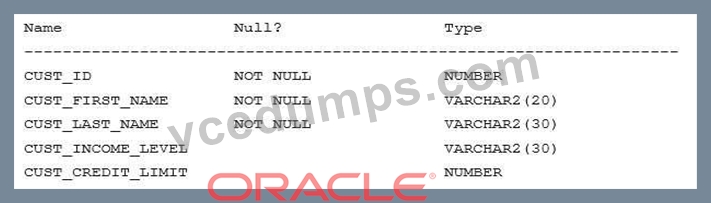
For customers whose income level has a value, you want to display the first name and due amount as 5% of their credit limit. Customers whose due amount is null should not be displayed.
Which query should be used?
- A. SELECT cust_first_name, cust_credit_limit * .05 AS DUE_AMOUNT
FROM customers
WHERE cust_income_level != NULL
AND due_amount !=NULL; - B. SELECT cust_first_name, cust_credit_limit * .05 AS DUE_AMOUNT
FROM customers
WHERE cust_income_level <> NULL
AND due_amount <> NULL; - C. SELECT cust_first_name, cust_credit_limit * .05 AS DUE_AMOUNT
FROM customers
WHERE cust_incoms_level IS NOT NULL
AND due_amount IS NOT NULL; - D. SELECT cust_first_name, cust_credit_limit * .05 AS DUE_AMOUNT
FROM customers
WHERE cust_income_level != NULL
AND cust_credit_level !=NULL; - E. SELECT cust_first_name, cust_credit_limit * .05 AS DUE_AMOUNT
FROM customers
WHERE cust_income_level IS NOT NULL
AND cust_credit_limit IS NOT NULL;
Answer: E
NEW QUESTION 31
In one of your databases, you create a user, HR, and then execute this command:
GRANT CREATE SESSION TO hr WITH ADMIN OPTION;
Which four actions can HR perform? (Choose four.)
- A. Execute DDL statements in the HR schema
- B. Grant the CREATE SESSION privilege with ADMIN OPTION to other users
- C. Revoke the CREATE SESSION privilege from other users
- D. Log in to the database instance
- E. Revoke the CREATE SESSION privilege from user HR
- F. Execute DML statements in the HR schema
Answer: B,C,D,E
Explanation:
Explanation
NEW QUESTION 32
Which two statements are true about the ORDER BY clause when used with a SQL statement containing a SET operator such as UNION? (Choose two.)
- A. Only column names from the first SELECT statement in the compound query are recognized
- B. Column positions must be used in the ORDER BY clause
- C. The first column in the first SELECT of the compound query with the UNION operator is used by default to sort output in the absence of an ORDER BY clause
- D. Each SELECT statement in the compound query can have its own ORDER BY clause
- E. Each SELECT statement in the compound query must have its own ORDER BY clause
Answer: A,D
NEW QUESTION 33
Which two statements are true?
- A. SALES1 is created with no rows.
- B. SALES1 is created with 1 row.
- C. SALES1 has primary key and unique constraints on any selected columns which had those constraints in the sales table.
- D. SALES1 is created with 55,000 rows.
- E. SALES1 has not NULL constraints on any selected columns which had those constraints in the sales table.
Answer: D,E
NEW QUESTION 34
Evaluate these commands which execute successfully: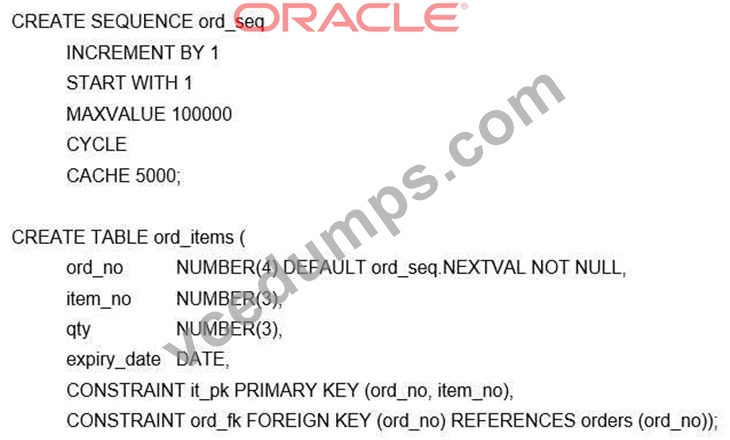
Which two statements are true about the ORD_ITEMS table and the ORD_SEQ sequence? (Choose two.)
- A. Any user inserting rows into table ORD_ITEMS must have been granted access to sequence ORD_SEQ
- B. Sequence ORD_SEQ is guaranteed not to generate duplicate numbers
- C. Sequence ORD_SEQ cycles back to 1 after every 5000 numbers and can cycle 20 times
- D. Column ORD_NO gets the next number from sequence ORD_SEQ whenever a row is inserted into ORD_ITEMS and no explicit value is given for ORD_NO
- E. If sequence ORD_SEQ is dropped then the default value for column ORD_NO will be NULL for rows inserted into ORD_ITEMS
Answer: A,B
NEW QUESTION 35
Which three statements are true about the Oracle join and ANSI join syntax? (Choose three.)
- A. The SQL:1999 compliant ANSI join syntax supports natural joins
- B. The Oracle join syntax supports creation of a Cartesian product of two tables
- C. The Oracle join syntax performs better than the SQL:1999 compliant ANSI join syntax
- D. The Oracle join syntax supports natural joins
- E. The Oracle join syntax only supports right outer joins
- F. The SQL:1999 compliant ANSI join syntax supports creation of a Cartesian product of two tables
- G. The Oracle join syntax performs less well than the SQL:1999 compliant ANSI join syntax
Answer: A,D,F
NEW QUESTION 36
The orders table has a column ORDER_DATE of data type date.
The default display format for a date Is DD-MON-RR.
Which two where conditions demonstrate the correct usage of conversion functions?
- A. WHERE order_date > TO_DATE<ADD_MONTHS(SYSDATE, c) , 'MON DD YYYY')
- B. WHERE order_date > TO_CHAR(ADD_MONTHS(SYSDATE, 6), 'MON DD YYYY')
- C. WHERE order_date IN (TO_DATE ('Oct 21 2018', 'Mon DD YYYY'), TC_CHAR('Nov 21 2018', 'Mon DD YYYY'))
- D. WHERE TO_CHAR(order_date, 'MON DD YYYY') = 'JAN 20 2019'
- E. WHERE order date > TO DATE('JUL 10 2018', *MON DD YYYY')
Answer: D,E
NEW QUESTION 37
Which three statements are true about data block storage in an Oracle Database?
- A. A table block must always contain row data.
- B. A block header contains a row directory pointing to all rows in the block.
- C. Row data is stored starting at the end of the block.
- D. An index block can contain row data.
- E. A data block header is of a fixed length.
Answer: B,E
NEW QUESTION 38
Which statement is true about the INTERSECT operator used in compound queries?
- A. INTERSECT is of lower precedence than UNION or UNION ALL
- B. It ignores NULLs
- C. Multiple INTERSECT operators are not possible in the same SQL statement
- D. It processes NULLs in the selected columns
Answer: D
NEW QUESTION 39
Examine the description of the customers table:
You need to display last names and credit limits of all customers whose last name starts with A or B in lower or upper case, and whose credit limit Is below 1000.
Examine this partial query:
SELECT cust_last_name, cust_credit_limit FROM customers
Which two where conditions give the required result?
A)

C)
D)
E)
- A. Option C
- B. Option E
- C. Option B
- D. Option A
- E. Option D
Answer: A,B
NEW QUESTION 40
......
View All 1Z0-082 Actual Free Exam Questions Updated: https://www.vcedumps.com/1Z0-082-examcollection.html
1Z0-082 Dumps Updated Feb 20, 2023 WIith 145 Questions: https://drive.google.com/open?id=1ZWGWhC5sgncK_aU6QmiSB0NLaAiinLun
